

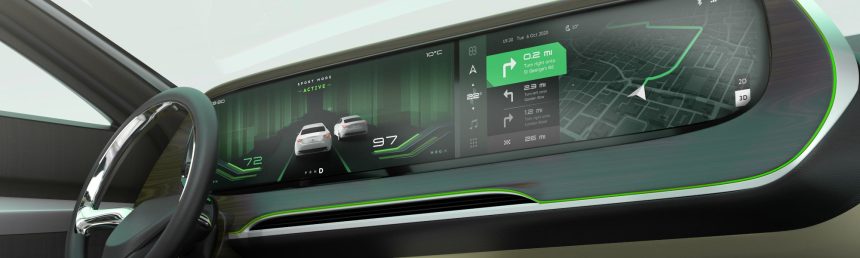
Automotive HMI Market Size, Growth & Trends: 2025–2035 | Complete Guide | March 2026
How voice controls, touchscreens, and AI interfaces are reshaping the driver experience — and where the $62.4 billion market is heading.
| Key Takeaways
• The Automotive HMI Market was valued at USD 29.8 billion in 2024 and is projected to reach USD 62.4 billion by 2035, growing at a 6.95% CAGR. • Voice recognition, gesture control, and augmented reality head-up displays are the fastest-growing interface technologies. • Asia-Pacific dominates with the largest market share, driven by China, Japan, and India’s high vehicle production volumes. • EV adoption is a key accelerator — electric vehicles rely heavily on digital dashboards for battery, range, and charging management. • AI-powered adaptive interfaces that learn driver behavior are emerging as the next major differentiator among OEMs. |
The Automotive Human-Machine Interface (HMI) market is undergoing a fundamental transformation. As vehicles evolve into software-defined, connected platforms, the dashboard is becoming a digital command center — and the interface between driver and machine is more critical than ever.
From capacitive touchscreens and natural language voice assistants to gesture controls and AR-powered heads-up displays, automakers are competing aggressively on the quality of the in-cabin experience. This guide covers the market size, key growth drivers, technology landscape, regional breakdown, and leading players shaping the next decade.
| Want the full dataset? Download the Free Sample PDF Report |
Automotive HMI Market Size & Growth Forecast
According to Market Research Future, the global Automotive HMI market was estimated at USD 29.8 billion in 2024. It is projected to grow from USD 31.87 billion in 2025 to USD 62.4 billion by 2035, representing a compound annual growth rate (CAGR) of 6.95% over the forecast period.
This growth is driven by the convergence of three major industry shifts: the electrification of vehicles, the rise of autonomous driving systems, and consumer demand for smartphone-level connectivity inside the cabin.
HMI Technology Comparison: Which Interface Is Winning?
Not all HMI technologies are equal. Here’s how the major interface types compare across deployment maturity, driver benefit, and adoption trend:
| Technology | How It Works | Key Benefit | Best Use Case | Trend |
| Touchscreen Display | Capacitive or resistive panel with haptic feedback | Intuitive, familiar smartphone-like UX | Infotainment, navigation, climate control | Mainstream — curved & high-res displays growing |
| Voice Recognition | NLP-based voice AI with multilingual support | Hands-free, eyes-on-road operation | Navigation, calls, media, EV battery queries | Fast-growing — conversational AI integration |
| Gesture Control | Camera/sensor-based hand-movement detection | Touch-free control in high-distraction zones | Volume, call accept/reject, display toggle | Emerging — premium segment adoption |
| Head-Up Display (HUD) | Projects data onto windshield using AR optics | Zero eyes-off-road navigation & alerts | Speed, navigation, hazard warnings | High growth — AR-HUD replacing legacy HUDs |
| Digital Instrument Cluster | Fully digital LCD/OLED gauge panel | Customizable, software-updatable dashboards | Speed, RPM, EV range, driver alerts | Standard in new launches — legacy analog declining |
| AI Adaptive Interface | ML models learn driver habits and preferences | Personalized, predictive control suggestions | Route prediction, seat/climate auto-adjust | Early stage — OEM differentiation battleground |
What Is Driving Automotive HMI Market Growth?
- Connected & autonomous vehicles: Advanced interfaces are required to manage navigation, real-time data, and multi-sensor fusion in semi-autonomous platforms.
- EV adoption surge: Electric vehicles depend on digital dashboards for battery status, range estimation, and charging management — HMI is core to the EV experience.
- Safety regulations: Government mandates promoting hands-free operation are accelerating adoption of voice, gesture, and HUD technologies globally.
- Smartphone parity expectations: Consumers expect seamless app connectivity, OTA updates, and personalized interfaces — pushing OEMs to upgrade cockpit technology.
- 5G and cloud connectivity: Real-time data processing and V2X communication are unlocking next-generation HMI capabilities beyond the vehicle itself.
Regional Market Breakdown
| Region | Market Maturity | Key Drivers | Outlook |
| Asia-Pacific | Dominant — largest share | High vehicle production in China, Japan, India; strong OEM presence | Fastest growing; India EV push adds significant demand |
| North America | High — premium adoption | Advanced tech investment; leading EV adoption; strong R&D ecosystem | Steady growth; autonomous vehicle programs accelerate HMI spend |
| Europe | High — innovation-led | Stringent safety regulations; sustainability mandates; major OEM base | Strong growth driven by NCAP requirements and EV transition |
| Latin America | Emerging | Rising vehicle sales; improving economic conditions | Gradual growth; cost-effective HMI solutions in demand |
| Middle East & Africa | Nascent | Increasing vehicle imports; luxury segment growth | Long-term opportunity; premium vehicle demand leads adoption |
India Spotlight
India represents a compelling growth story within Asia-Pacific. Rapid EV adoption across the two- and three-wheeler segment, the PLI scheme for Advanced Chemistry Cell batteries, and the entry of connected car platforms from Tata Motors, Mahindra, and Maruti Suzuki are collectively expanding the addressable HMI market.
Domestic consumers — particularly in Tier 1 cities — are increasingly choosing vehicles with digital clusters, voice-enabled infotainment, and app-connected dashboards. Government-backed highway expansion is also driving demand for navigation-integrated HMI in commercial vehicles.
Competitive Landscape: Who Are the Major Players?
The Automotive HMI market is highly competitive, with global Tier 1 suppliers and technology companies racing to integrate AI, AR, and connectivity into cockpit platforms.
Leading players include Continental AG (Germany), Robert Bosch GmbH (Germany), Denso Corporation (Japan), Harman International (US), Visteon Corporation (US), NVIDIA Corporation (US), Magna International (Canada), Aptiv PLC (Ireland), and Faurecia (France).
Key competitive strategies include AI-driven voice assistant integration, touchless AR interface development, and strategic OEM partnerships. Emerging regional players — particularly in China and India — are gaining traction with cost-competitive, customized cockpit solutions.
Frequently Asked Questions
What is Automotive HMI?
Automotive HMI (Human-Machine Interface) refers to all the systems and technologies that enable a driver or passenger to interact with a vehicle — including touchscreens, voice assistants, gesture controls, digital dashboards, and heads-up displays.
How big is the Automotive HMI market?
The market was valued at USD 29.8 billion in 2024 and is forecast to reach USD 62.4 billion by 2035, growing at a CAGR of 6.95%.
Which region leads the Automotive HMI market?
Asia-Pacific holds the largest market share, driven by China, Japan, and India’s large vehicle production volumes and fast-growing EV adoption.
What technologies are transforming in-vehicle interfaces?
AI-powered voice recognition, augmented reality head-up displays (AR-HUD), gesture control, and adaptive ML-based interfaces are the most disruptive technologies currently reshaping automotive HMI.
How does EV growth affect the HMI market?
Electric vehicles require sophisticated digital interfaces for battery monitoring, range estimation, and charging management — making advanced HMI systems a standard feature rather than a premium add-on, directly boosting market demand.
| Access the complete market intelligence: Buy the Full Automotive HMI Market Report |
Related Market Reports
Explore adjacent markets covered by Market Research Future: